
La Bottega di Nello

The silversmiths’ workshop

The wise man blows away his own impurities little by little,
one moment after another,
as the silversmith does with silver.
(Buddha)

Anno Domini 1791. By official concession of the Mint Commissioners of the Most Serene Republic of Lucca, the silversmith Giovanni Bastiani is granted the licence to practise the craft in accordance with the Statute of the “Guild of Goldsmiths and Silversmiths”.
For over two hundred years, the Workshop has lived on through the majestic, albeit small, work of its artisans, who over the years have been its makers, lovers and keepers: first the Bastiani, then the Favilla, and finally the Giovacchini kept the silversmith’s trade within the narrow family circle, handing down the precious secret of the art from father to son. In the tree-lined circle of Lucca, “on the corner of the Archbishopric”, La Bottega di Nello (which today takes its name from Nello Giovacchini, who passed away in 2013, moral heir to the tradition and father of the sculptor Cesare) occupies the ground floor of a house dating back to the Middle Ages, with the small shop window looking onto the square behind the Cathedral. Those who approach out of curiosity can hear the sound of a subdued hammering, the light dull scratch of the fretsaw; they can admire the hands of Cesare Giovacchini as they model, emboss and engrave, while he sits in a corner of the city where past and present blend, creating an indissoluble bond. The artisan is assisted by his cousin Angelo, to whom he will leave the business as his legacy: together, dawn after dawn, they create sacred and profane art, body and soul; the goldsmith’s and silversmith’s licence, jealously guarded, watches over their work from above, as if to keep them constantly under examination. It is the very location of the Workshop that suggests its original activity (and still today its most important one): the crafting of sacred silverware and liturgical furnishings. The artisans also carry out restoration work on antique silver, work that always requires careful preliminary research; for this reason the figure of the workshop silversmith “always represents a middle ground between the artisan-artist and the art historian” [1], uniting technical knowledge and critical awareness.
In 2010, the artistic and human events of the Workshop took shape in the degree thesis of Marta Giovacchini, Cesare’s daughter, and were then reworked in the form of a volume entitled Eredità di una Bottega di Argentieri a Lucca (Maria Pacini Fazzi Editore).

[1] Cit. Marta Giovacchini, Eredità di una Bottega di Argentieri a Lucca, MPF Editore, 2014
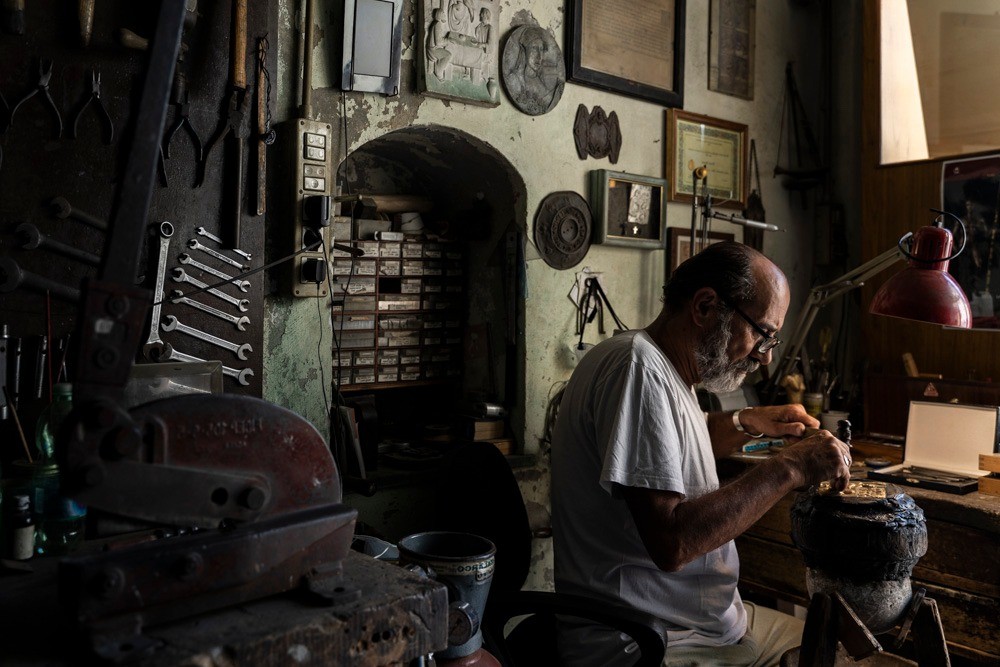
silversmith artisans in the bottega di nello

the silversmith artisans of the bottega di Nello

La Bottega di Nello

L’atelier des orfèvres

L’homme sage souffle ses impuretés peu à peu,
un instant après l’autre,
comme l’orfèvre le fait avec l’argent.
(Bouddha)

Anno Domini 1791. Par concession officielle des Commissaires de la Monnaie de la Sérénissime République de Lucques, l’orfèvre Giovanni Bastiani reçoit la licence pour exercer l’art selon ce qu’établit le Statut de la « Guilde des Orfèvres et des Argentiers ».
Depuis plus de deux cents ans, l’Atelier vit à travers l’œuvre majestueuse, bien que petite, de ses artisans, qui, au fil des ans, en ont été les auteurs, les amants, les gardiens : d’abord les Bastiani, puis les Favilla, enfin les Giovacchini ont maintenu le métier d’orfèvre au sein du cercle familial restreint, se transmettant de père en fils le précieux secret de l’art. Dans le cercle arboré de Lucques, « au coin de l’Archevêché », La Bottega di Nello (qui aujourd’hui tient son nom de Nello Giovacchini, disparu en 2013, héritier moral de la tradition et père du sculpteur Cesare) occupe le rez-de-chaussée d’une maison remontant au Moyen Âge, avec la petite vitrine qui donne sur la place située derrière la Cathédrale. Celui qui s’approche, intrigué, peut écouter le son d’un martèlement discret, le léger grattement sourd de la scie à chantourner ; il peut admirer les mains de Cesare Giovacchini qui modèlent, repoussent, gravent, tandis qu’il est assis dans un coin de ville où passé et présent se fondent, créant un lien indissoluble. L’artisan est secondé par son cousin Angelo, à qui il laissera l’activité en héritage : ensemble, aube après aube, ils réalisent art sacré et profane, corps et âme ; la patente d’orfèvre et d’argentier, jalousement conservée, surveille leur travail d’en haut, comme pour les tenir constamment sous examen. C’est l’emplacement même de l’Atelier qui suggère son activité première (et aujourd’hui encore la plus importante) : le travail des objets d’argenterie sacrée et des ornements liturgiques. Les artisans s’occupent aussi d’interventions de restauration sur des argents anciens, interventions qui nécessitent toujours un minutieux travail de recherche en amont ; c’est pourquoi la figure de l’orfèvre d’atelier « représente toujours une terre du milieu entre l’artisan-artiste et l’historien de l’art » [1], unissant savoir technique et conscience critique.
En 2010, les événements artistiques et humains de l’Atelier se sont concrétisés dans le mémoire de maîtrise de Marta Giovacchini, fille de Cesare, puis ont été retravaillés sous la forme d’un ouvrage intitulé Eredità di una Bottega di Argentieri a Lucca (Maria Pacini Fazzi Editore).

[1] Cit. Marta Giovacchini, Eredità di una Bottega di Argentieri a Lucca, MPF Editore, 2014
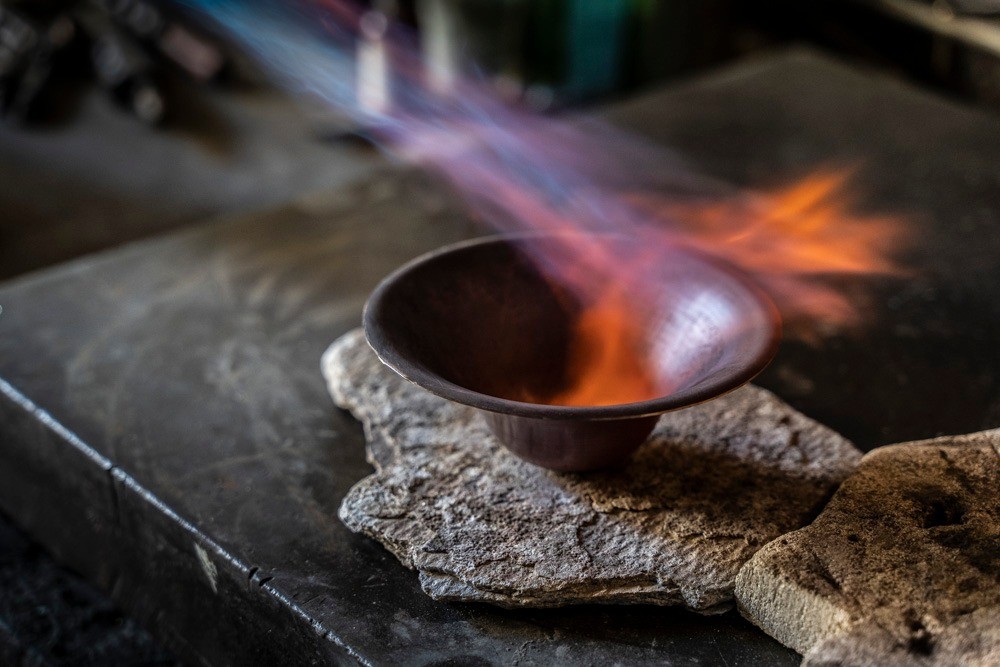
artisans orfèvres dans la bottega di nello

les artisans orfèvres de la bottega di Nello