
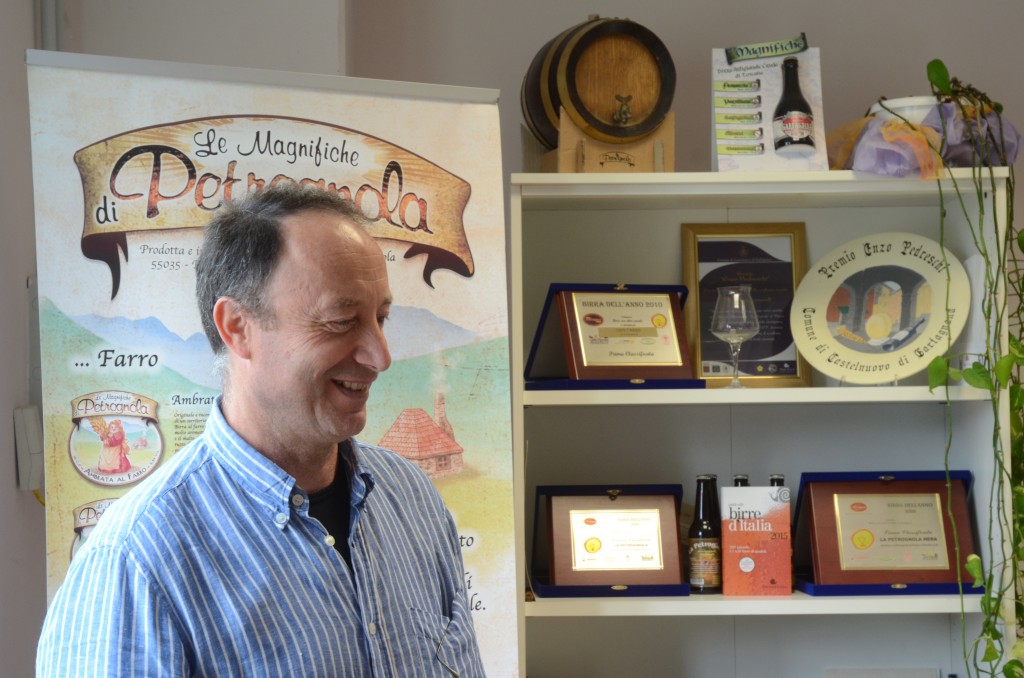
Roberto has a brewery, in Petrognola, in the Garfagnana, the land of spelt. It is precisely from this ancient cereal that his beer takes its fragrance. Here he tells the story of his brewery… which is then, inseparably, his own.
How did I get the idea of becoming a brewer in the land of wines?
I too, before, always made wine; I have a vineyard in Petrognola, which I grafted myself, and now I have entrusted it to a man from the village.
I am the son of farmers, a farmer myself, and this obsession with beer came to me in the early ’80s. In those years I was a haulier, I drove my truck and I saw the hops climbing up the electricity poles, along the fences, in the rivers, where I worked at that time. And I already had this idea in mind, but I had to drive the truck, I did not have the means to travel, go abroad, gain knowledge… At 20 I met my wife, I fell in love and so I no longer left; I stayed here, but I kept that dream.
 One day, in a magazine, my brother-in-law finds an address to buy a production kit. So I got this kit… but it was disappointing. With the kits you do nothing but add hot water and finish the process… nothing wrong with that, but you do nothing creative.
Then I also tried the All Grain, with the grains themselves, but that way I could make 10, 20 litres — sometimes it comes out well, sometimes badly — and you cannot control the fermentation. In short, in the end I bought the 100-litre plant, but I waited two years for the licence… I kept it in the house, in a room 4 metres by 4, with the fermentation room 1.70 by 2… I don’t know how my wife managed not to throw me out of the house!
After a year I renovated the old stable and installed the 500-litre plant,
and there I stayed until 2010… From there I moved nearby, into a 250-square-metre shed, with the same plant, but I expanded the cellar, and I got to make up to 4,000 litres a week.
And then, in 2013, we finally moved here. Now we produce from 4,000 to 6,000 litres a week, but at more human rhythms than in the past years.
If I have come this far, it is only out of passion, certainly not to do business. Behind here, there is no business: there is a lot of work, expenses, toil and sacrifice… and satisfaction!
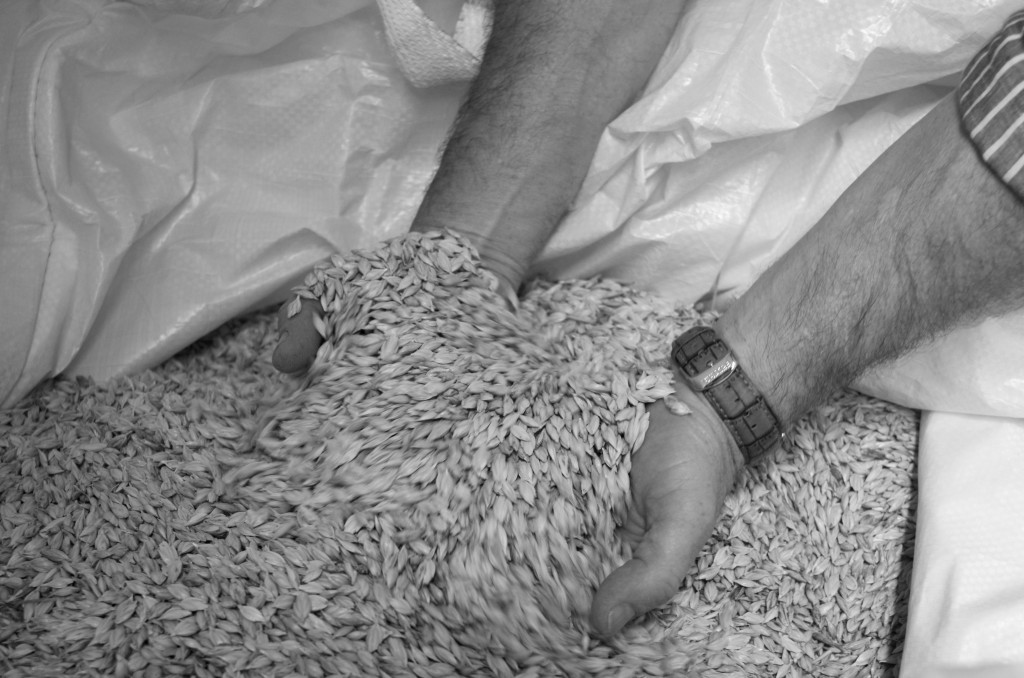
Every master brewer has his recipes. For us, making a recipe is a bit like a poem for a poet… by saying this I don’t want to seem an artist, on the contrary, I define myself as a brewer, and I have almost 1,300 brews…
In the northern countries beer was an important food, as wine is for us here. I remember when my mother came into the field, with breakfast in the basket, which she carried on her head, with bread, pancetta, cured meats, cheeses and wine inside. We ate, we had a nice glass of wine — which at that time was 8°/9° degrees, not 13°/14° like now — and we went on all day.
And likewise beer was a food in the northern countries, prepared at home, by the women, each with her All-Grain pot. In the village, however, there was also the brewery. The one who worked there, that was the Master Brewer! And he not only made the beer… he knew everything about agriculture, the sowing time of the barley, the qualities to plant in that place, where to plant them, when to take it, how to malt it — he knew the whole process! And then he himself turned that product into food. Liquid and solid. Because beer is nothing but liquid bread. If you look closely, the ingredients are the same: flour, water, yeast. Nothing else. It is bread, liquid. In different proportions, you get one product or the other.
That is why, many times, when they say to me “you are the master brewer”, I answer “mmm, no, let’s take it easy”.
For those of my generation, pupils of the true pioneers of Beer, one is a brewer at 1,000 brews, and a Master Brewer at 2,000. At the thousandth brew, I still remember it, I sent a message to my teacher and told him “today I am a brewer”… it was about a year ago…
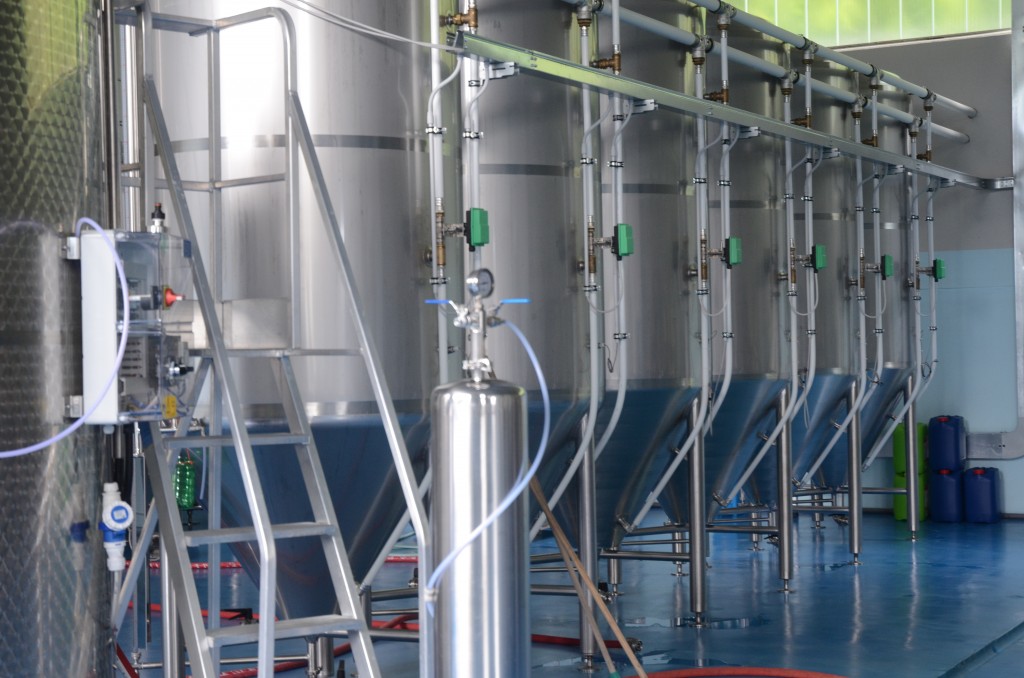
The brewery is divided into three large environments, in each of which different operators work without interfering with one another. In the laboratory the raw materials arrive, are ground, and the elaboration process begins, which ends in the large vats where fermentation takes place. In the same environment there is the bottling machine. An opening joins the laboratory to the refermentation cell. The two environments are separated and must not come into contact, for bacteriological reasons. We would like to build an internal laboratory precisely for microbiology, to improve more and more, because we are in continuous pursuit of quality. Without that, you get nowhere.
The third environment is the warehouse for shipping, the loading and unloading area.
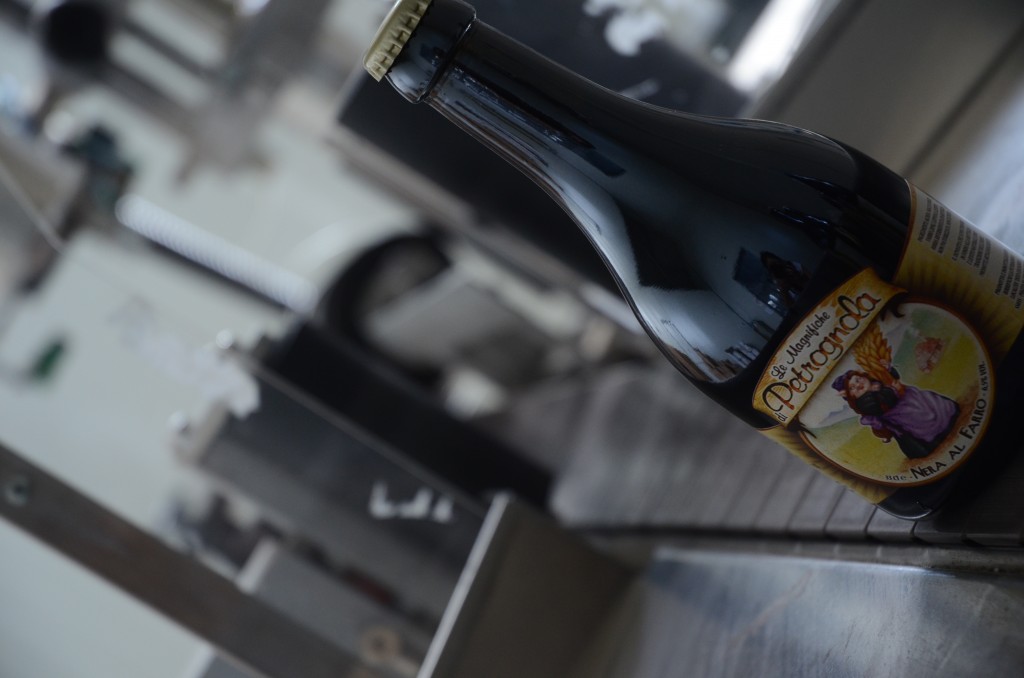
In the refermentation cell there is a precise temperature, summer and winter, because here the beer, once bottled, must referment inside the bottle itself. With the champenoise method in wine the yeasts are brought onto the cork to then be expelled; here, instead, they are brought to the bottom, because they are a particular characteristic of this type of beer — in general, of craft beer. One must always bear in mind that we are dealing with living things; the yeasts, in fact, are single-celled organisms but are nonetheless living beings. So they have “their behaviours”, they are very susceptible to temperature changes, movements and so on. This is why communication between producer, seller and consumer is very important, because each bottle can react differently, depending on where it is stored, opened and consumed. There are living beings… and this is an added value…
In my brewery I welcome visitors, organising small guided tours in which I myself explain the various stages of beer production, from the arrival of the raw materials to the bottled product.
Birrificio La Petrognola
Piazza al Serchio, loc. Petrognola
tel. 0583.605825 / 338.1533845 – info@lapetrognola.com
www.lapetrognola.com